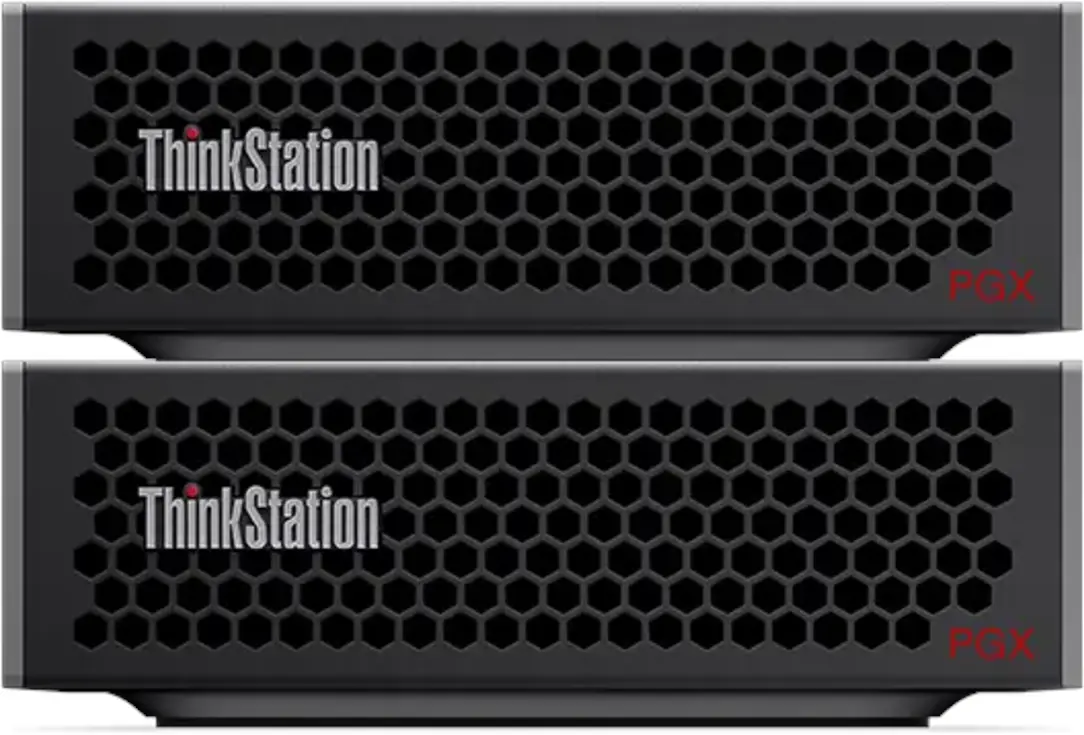
Lenovo ThinkStation PGX
Use this to tell your different configurations apart in your cart — handy if you order the same product with different options.
Full Specifications
Compute & Memory
Chip
NVIDIA GB10 Grace Blackwell Superchip
Unified Memory
128 GB LPDDR5x (273 GB/s bandwidth)
AI Performance
1 PetaFLOP (FP4)
Storage & Physical
Storage
1 TB or 4 TB self-encrypting NVMe (PCIe Gen4)
Dimensions
150 x 150 x 50.5 mm
Weight
1.2 kg
Security & Compliance
Trusted Platform
TPM 2.0
Secure Enclave
NVLink-C2C hardware secure enclave
Boot & Storage Security
UEFI Secure Boot, AES self-encrypting NVMe (AES-SED)
Power & Thermal
Power Supply
240 W USB-C PD adapter (91% efficient @ 50% load)
Power Draw
~38–40 W idle · 104–160 W sustained · <200 W peak
Cooling
Dual custom blower fans, copper heat-pipe heatsink
Connectivity & Software
Networking
2 × 200 Gbps QSFP (ConnectX-7), 10 GbE, Wi-Fi 7, Bluetooth 5.3
Operating System
Lenovo Custom DGX OS (Ubuntu Linux Pro base)
In the Box
USB-C to USB-A adapters included
The Lenovo ThinkStation PGX was officially announced on October 13, 2025, bringing Lenovo's enterprise workstation heritage to the NVIDIA GB10 Grace Blackwell Superchip platform. Rather than positioning the device as a bare compute appliance, Lenovo engineered the PGX from the outset as a corporate-deployable AI workstation, built around IT-familiar service, security, and support practices.
While sharing the same 1 petaFLOP compute foundation found across the GB10 class, the ThinkStation PGX differentiates itself through an enterprise-grade security architecture — TPM 2.0 combined with an NVLink-C2C secure enclave and self-encrypting NVMe storage — packaged inside an ultra-compact 150 x 150 x 50.5 mm chassis engineered for IT-managed corporate environments.
Hardware Specifications
The ThinkStation PGX delivers 1 petaFLOP of FP4 AI performance from the NVIDIA GB10 Grace Blackwell Superchip, paired with 128 GB LPDDR5x unified memory offering 273 GB/s bandwidth shared coherently between CPU and GPU. Storage ships as a self-encrypting NVMe module available in 1 TB or 4 TB capacities on PCIe Gen4, using AES hardware encryption (AES-SED) at the drive level.
Connectivity & Networking
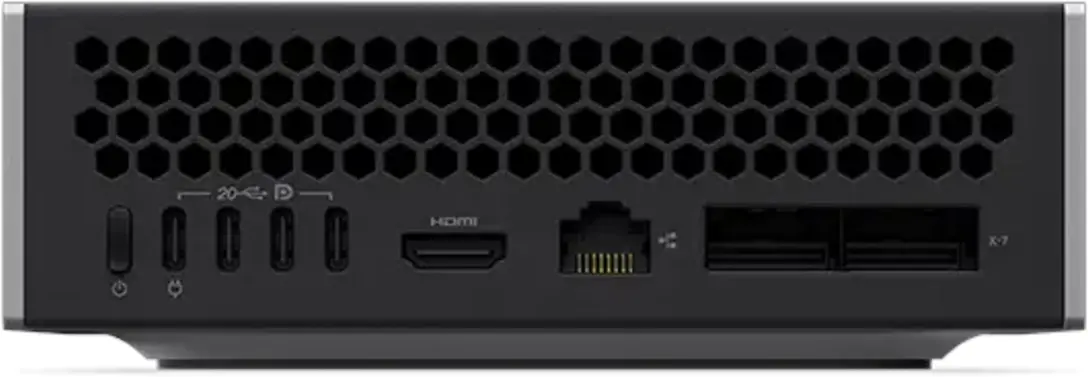
The ThinkStation PGX integrates an NVIDIA ConnectX-7 Smart NIC with dual 200 Gbps QSFP ports for direct unit-to-unit clustering, alongside a 10 GbE RJ-45 port, Wi-Fi 7 (802.11be), and Bluetooth 5.3 for standard office network integration. I/O comprises 4 × USB-C (USB4, 20 Gbps) with DisplayPort 2.1 alt-mode support and HDMI 2.1a. Uniquely among GB10 systems, the PGX ships with USB-C to USB-A adapters included in the box.
Software & Enterprise Integration
The PGX is preloaded with a Lenovo-customized DGX OS foundation built on Ubuntu Linux Pro, chosen specifically for long-term enterprise software support and easier alignment with corporate IT management policies. The full NVIDIA AI software stack ships pre-installed — CUDA, PyTorch, Jupyter Notebooks, NVIDIA AI Workbench, and a GB10 monitoring dashboard — so developers can prototype and fine-tune models immediately from the desktop. The platform is also designed to interoperate with Lenovo's Hybrid AI enterprise platforms, allowing models developed locally on the PGX to move to larger on-premises or cloud deployments with minimal rework.
Design & Serviceability
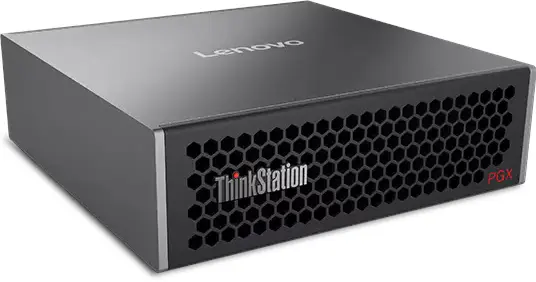
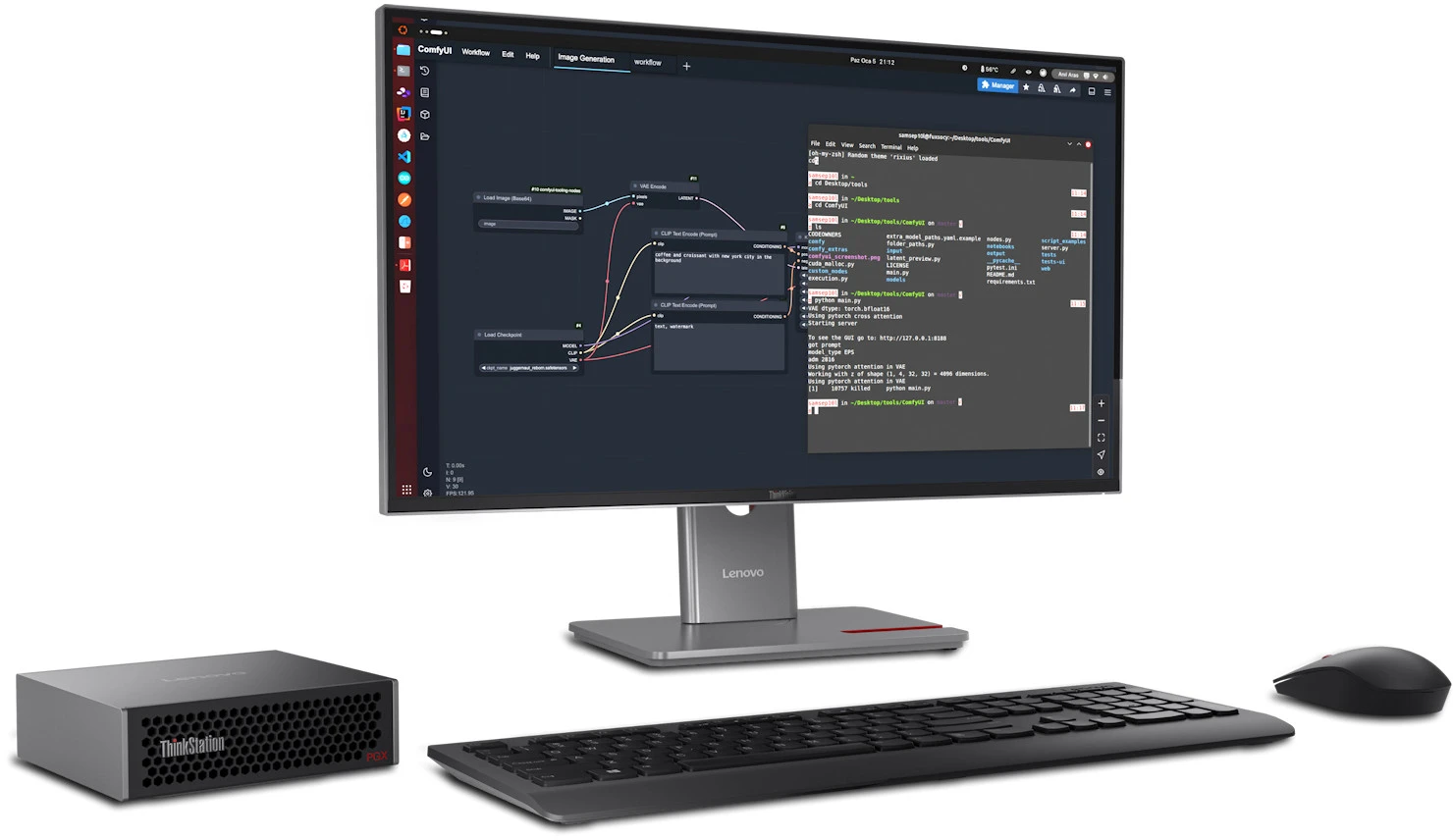
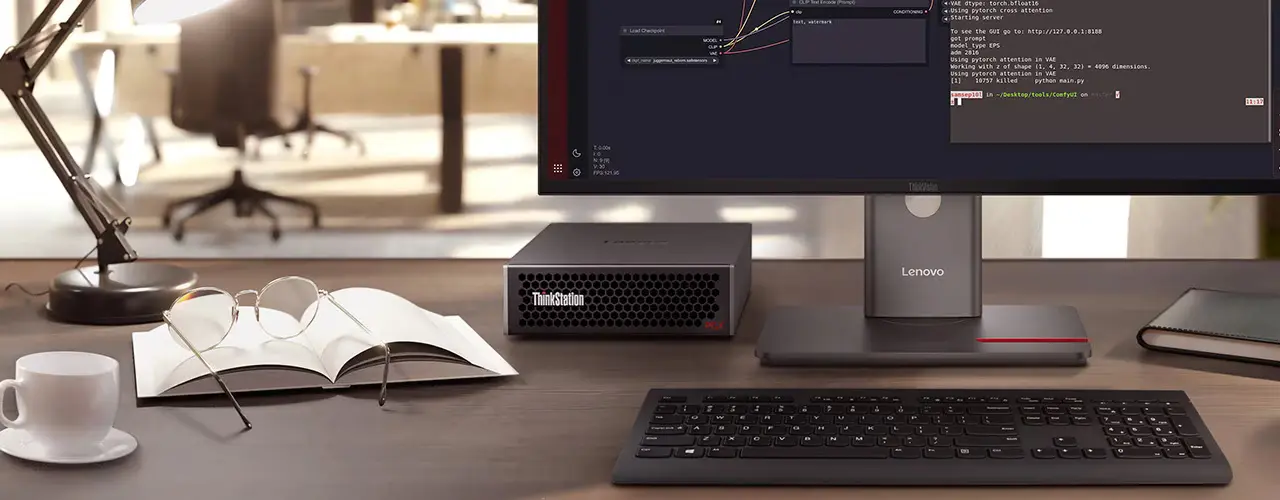
At just 150 x 150 x 50.5 mm and 1.2 kg, the ThinkStation PGX uses a deliberately understated black chassis with hexagonal ventilation, designed to blend into office environments rather than draw attention on a desk. A bottom access panel secured by four screws under the rubber feet allows IT staff to service the unit without specialized tools, and a rear QR code links directly to support resources — details reflecting a design built for fleet deployment rather than a single enthusiast's desk.
Independently-Tested Performance
Independent testing by ServeTheHome found the ThinkStation PGX delivers a consistent single-core performance advantage over comparable GB10-class systems — measured at approximately 3.7% across every single-core test run — while multi-core throughput remained within 0.5% of parity, as expected given the shared underlying GB10 silicon. In sustained heat-soak testing across eight distinct AI inference workloads, the PGX matched or edged ahead of comparable systems in the majority of runs, a result attributed to its custom dual-blower thermal design and firmware tuning rather than raw hardware differences.
Thermal Efficiency & Power Management
Cooling is handled by dual custom-designed blower fans paired with a copper heatsink and multiple heat pipes routed directly from the GB10 package, using front-to-back airflow tuned for the compact chassis. The bundled 240 W USB-C power adapter is a Lenovo-designed unit (rather than an off-the-shelf reference design) rated at 91% efficiency at 50% load. Independently measured power draw stays predictable across all operating states: approximately 38–40 W at idle (including networking overhead from the ConnectX-7 NIC), 104–160 W during sustained inference workloads, and just under 200 W at peak — comfortably inside the adapter's rated headroom.
Two-Unit Cluster Scaling
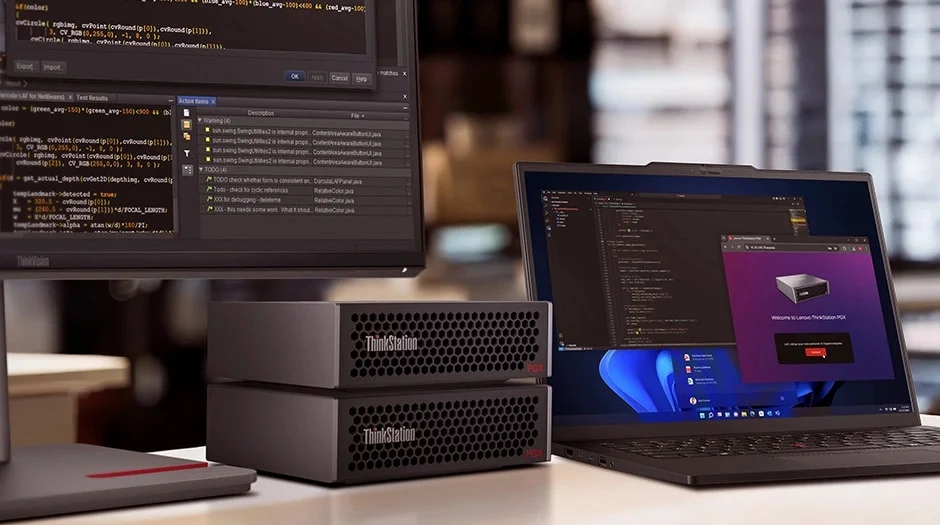
Two ThinkStation PGX units can be linked directly via their ConnectX-7 200 Gbps QSFP ports using a peer-to-peer DAC cable, an NVIDIA-validated topology for the GB10 platform. This combines 256 GB of total unified memory across the pair and enables inference on models up to roughly 400 billion parameters using distributed-inference frameworks such as vLLM, DeepSpeed, or Megatron-LM with tensor- or pipeline-parallel sharding. The clustering capability is fully supported under Lenovo's standard warranty terms.
Ecosystem & Enterprise Support
The ThinkStation PGX ships as an NVIDIA-certified system with direct continuity into Lenovo's broader Hybrid AI enterprise platforms, allowing organizations to scale from desktop prototyping to on-premises or cloud-hosted deployment without re-architecting their models. Lenovo's enterprise support offerings, including Premier Support and data-retention service options, extend the standard warranty into the kind of service relationship corporate IT departments already expect from fleet hardware purchases.