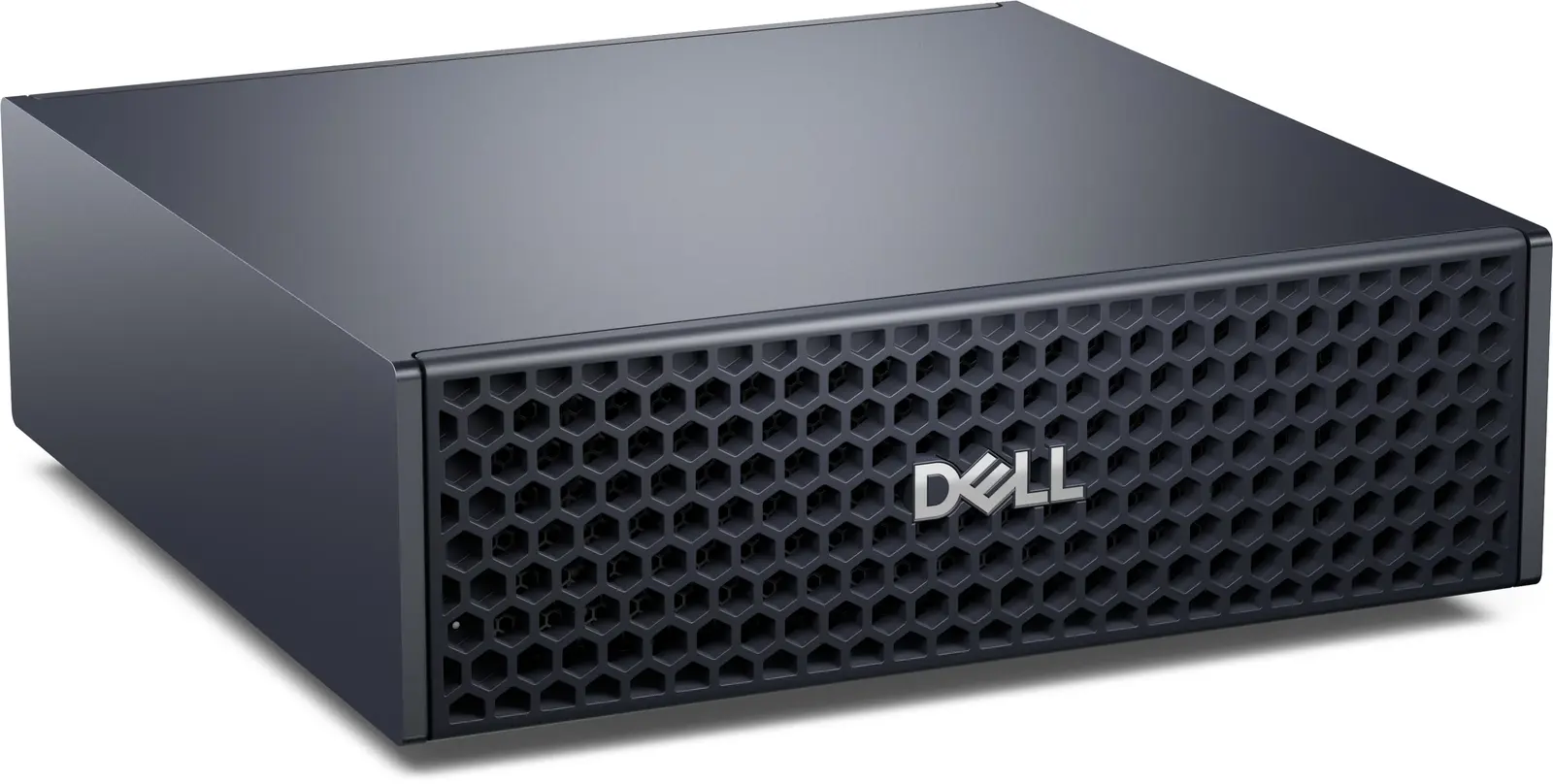
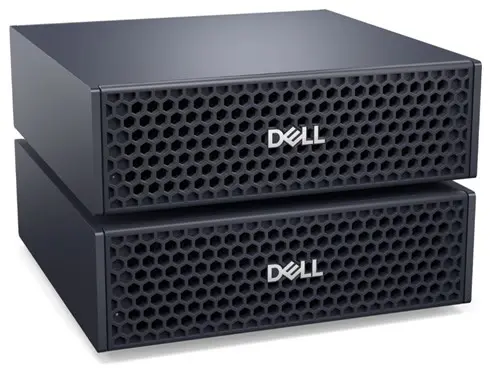
Dell Pro Max with GB10
Use this to tell your different configurations apart in your cart — handy if you order the same product with different options.
Full Specifications
Compute & Memory
Chip
NVIDIA GB10 Grace Blackwell Superchip
Unified Memory
128 GB LPDDR5x (273 GB/s bandwidth)
AI Performance
1 PetaFLOP (FP4)
Max Model Capacity
~200B inference · ~70B fine-tuning (single unit)
Storage & Physical
Storage
Up to 4 TB PCIe Gen4 NVMe SSD
Dimensions
150 x 150 x 51 mm
Weight
1.3 kg
Chassis
Gunmetal gray L6 enterprise chassis
Power & Thermal
Power Supply
280 W USB-C PD adapter
Cooling
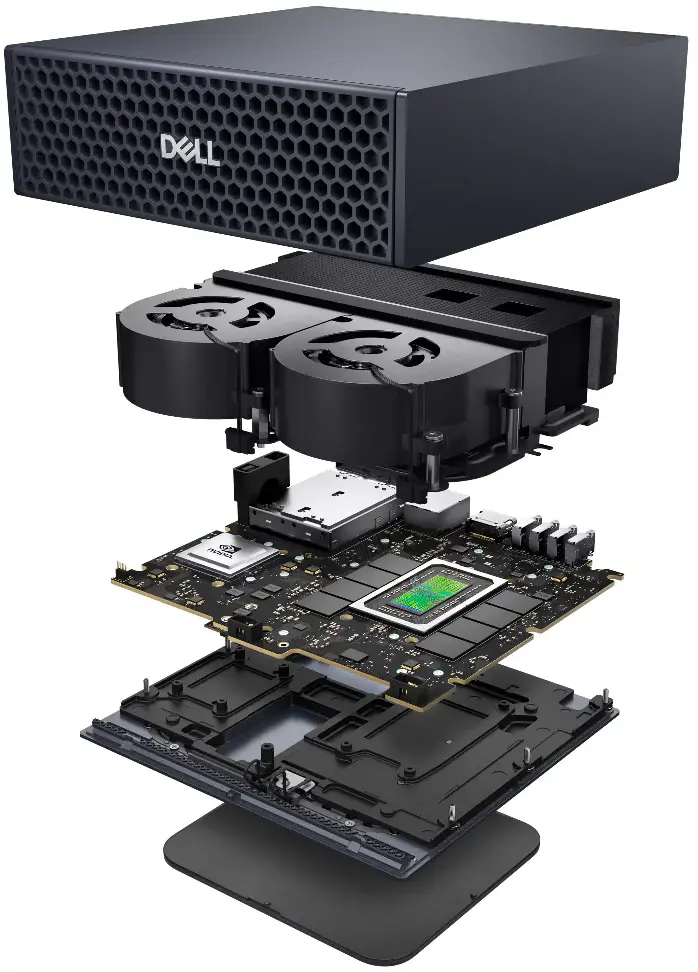
Front-to-back airflow, enterprise-tuned
Sustained Thermal Profile
CPU holds steady near 83 °C under sustained decode-heavy load, without throttling
Security & Compliance
Certification
TAA (Trade Agreements Act) compliant
Security
TPM 2.0, Secure Boot
Enterprise Support
Support Plan
ProSupport Plus for PCs
Services
24/7 priority support, next-business-day on-site repair, consulting & training
The Dell Pro Max with GB10 pairs the NVIDIA GB10 Grace Blackwell Superchip with Dell's enterprise engineering discipline, producing an on-premises AI workstation built for organizations that cannot compromise on compliance, reliability, or long-term support. It is the first system in the NVIDIA GB10 ecosystem to achieve TAA (Trade Agreements Act) certification, opening the platform to federal, defense, and public-sector procurement channels that require verified supply-chain compliance.
Beyond compliance, the Pro Max is engineered for sustained, unattended workloads: a 280 W USB-C power delivery adapter—well above the class-typical 240 W—gives the system meaningful thermal and performance headroom during long-running inference and fine-tuning jobs, backed by a front-to-back airflow chassis specifically tuned to avoid throttling during multi-hour sessions.
Hardware Specifications
At its core, the Pro Max delivers 1 petaFLOP of FP4 AI performance from a 20-core Arm-based processor (10 × Cortex-X925 performance cores + 10 × Cortex-A725 efficiency cores), paired with 128 GB LPDDR5x unified memory delivering 273 GB/s of bandwidth. This is sufficient to run inference on models up to approximately 200 billion parameters directly on the desktop, or fine-tune models up to roughly 70 billion parameters without leaving the device.
Connectivity & Networking
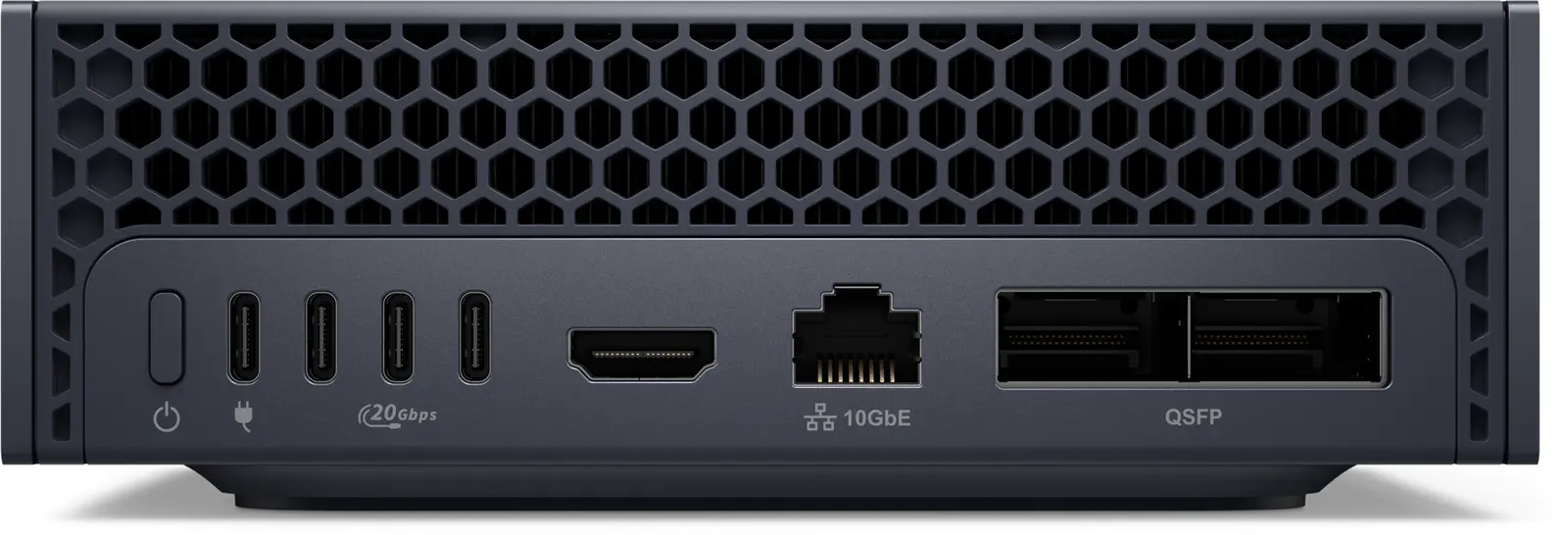
An integrated NVIDIA ConnectX-7 Smart NIC with dual 200 Gbps QSFP ports provides both high-throughput data-center-grade networking and the direct unit-to-unit link required for multi-node scaling. Additional connectivity includes 10 GbE Ethernet (RJ-45), Wi-Fi 7, and Bluetooth 5.4. I/O comprises 3 × USB 3.2 Gen 2×2 Type-C (20 Gbps) and HDMI 2.1. A physical LED power indicator built into the USB-C cable itself gives at-a-glance power status, a small but deliberate refinement over reference-design GB10 systems.
Dual-Unit Clustering
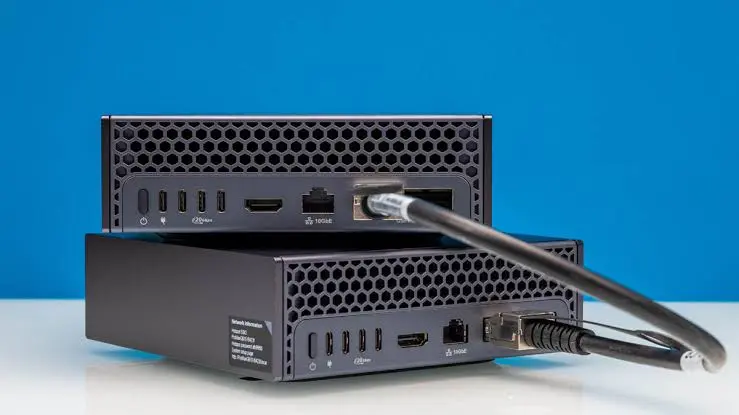
Two Pro Max units can be linked directly via their ConnectX-7 ports to form a coherent 2-node cluster, combining to 256 GB of unified memory and roughly 2 petaFLOPS of FP4 compute—enough headroom to run models in the ~400 billion parameter class entirely on-premises. The link is officially supported, vendor-backed, and covered under Dell's enterprise warranty terms, with published deployment guidance covering coordinated dual-unit LLM hosting.
Memory & Scaling Architecture
| Component | Single Unit | 2-Unit Cluster (ConnectX-7) |
|---|---|---|
| Total Memory | 128 GB LPDDR5x | 256 GB (2 × 128 GB) |
| AI Performance | 1 PetaFLOP (FP4) | ~2 PetaFLOPS (FP4) |
| Local Memory Bandwidth (per node) | 273 GB/s | 273 GB/s (per node) |
| Inter-Node Link | N/A | Direct ConnectX-7 QSFP link, 200 Gbps |
| Max Model Parameters | ~200B (inference) / ~70B (fine-tuning) | ~400B+ |
Software & Enterprise AI Platform
The Pro Max ships with NVIDIA DGX OS and the full NVIDIA AI software stack pre-installed and pre-validated—CUDA, JupyterLab, Docker, and AI Workbench are ready immediately after unboxing. Dell bundles access to NVIDIA Playbooks, a library of guided, pre-built workflow recipes covering document analysis, image generation, and workflow automation, alongside NVIDIA Sync for remote monitoring and control of the system from a laptop on the same network. Dell additionally publishes documented multi-node deployment architectures—including semantic query routing and coordinated dual-unit LLM hosting—so teams can move from prototype to production configuration with a validated blueprint rather than starting from scratch.
Federal & Enterprise Compliance
The Pro Max is TAA-certified, qualifying it for U.S. federal agency and government contractor procurement—a distinction not shared by consumer-oriented GB10 systems. Hardware-rooted security is provided via TPM 2.0 and secure boot, supporting zero-trust architectures and simplifying FISMA-aligned compliance reviews. Because inference and fine-tuning are performed entirely on-premises, sensitive or classified data never needs to leave the facility, making the system well suited to defense, healthcare, legal, and financial workloads with strict data-residency requirements.
Enterprise Support & Services
Every Pro Max is backed by ProSupport Plus for PCs: 24/7 priority access to technical specialists, next-business-day on-site repair, automated hardware issue detection, and accidental damage coverage. For teams scaling beyond a single unit, Dell also offers consulting and residency services—embedded specialists who assist with deployment and orchestration—plus formal training programs to accelerate internal team readiness.
Ecosystem & Future Scaling
The Pro Max is aligned with the broader Dell AI Factory ecosystem: workloads prototyped on a single desktop unit are designed to move to a linked dual-unit configuration, and ultimately to larger Dell data center infrastructure, without requiring a rewrite of the underlying software stack. This gives teams a clear, low-friction growth path as model and workload requirements increase over time.