ASUS Ascent GX10
Use this to tell your different configurations apart in your cart — handy if you order the same product with different options.
Full Specifications
Compute & Memory
Chip
NVIDIA GB10 Grace Blackwell Superchip
Unified Memory
128 GB LPDDR5x (273 GB/s bandwidth)
AI Performance
1 PetaFLOP (FP4)
Storage & Physical
Storage
4 TB NVMe Gen5
Dimensions
150 x 150 x 51 mm
Weight
1.5 kg
Display Outputs
Up to 5 simultaneous displays (HDMI 2.1 + USB-C DisplayPort 2.1 alt-mode)
Power & Thermal
Power Supply
240 W USB-C PD 3.1 EPR adapter
GPU Power Draw
69.77 W
Cooling
QuietFlow dual vapor chamber, dual 140mm fans, 5 heat pipes, 7-level fan control
Thermal Profile
CPU: 87.3 °C peak · GPU: 82 °C peak
Design & Security
Chassis
Toolless design; front-mounted power button with status LED
Durability
MIL-STD-810H tested
Security
TPM 2.0, Secure Boot
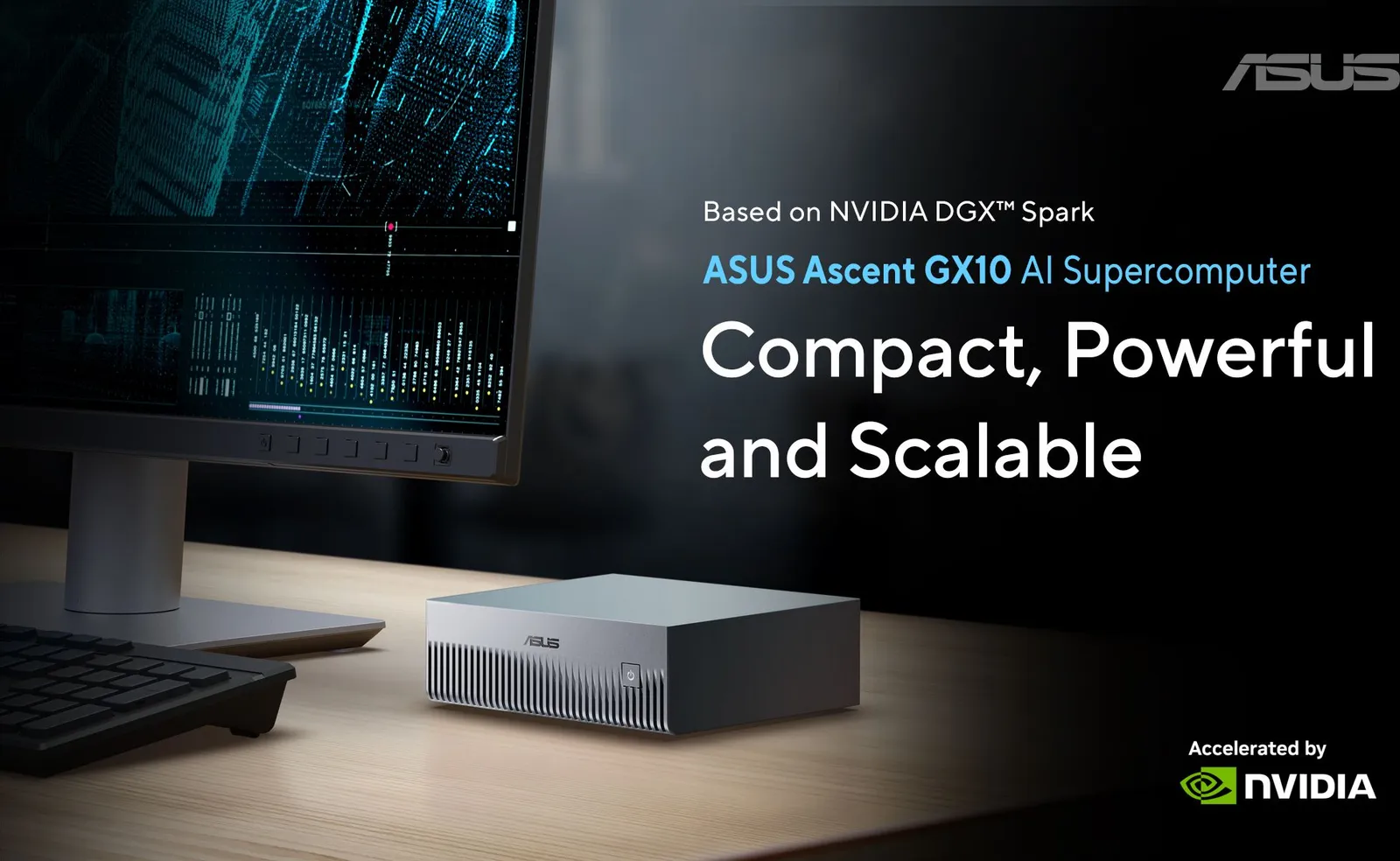
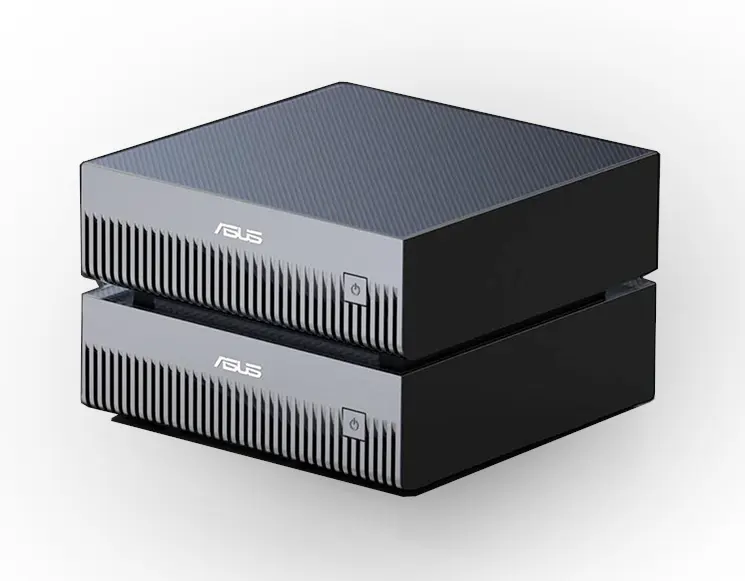
ASUS introduced the Ascent GX10 on October 14, 2025, bringing the NVIDIA GB10 Grace Blackwell Superchip to a compact, toolless desktop chassis built for sustained local AI development. The system shipped ready to link two units via a direct ConnectX-7 connection, doubling combined performance to 2 petaFLOPS and unified memory to 256 GB.
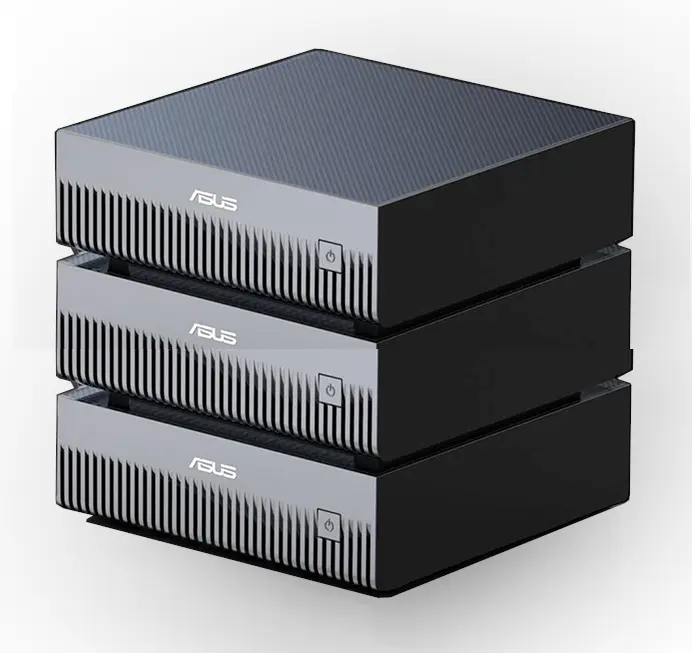
On April 16, 2026, ASUS extended the Ascent GX10's clustering support to three linked units, raising combined unified memory to 384 GB and enabling inference on mixture-of-experts models of up to 800 billion parameters, while keeping the same compact footprint and toolless upgrade path as the single unit.
The Ascent GX10 pairs this GB10 platform with a set of practical, ASUS-engineered refinements: a front-mounted power button with an integrated status LED, QuietFlow dual vapor-chamber cooling tuned for sustained AI workloads, a toolless chassis for fast storage and memory servicing, and MIL-STD-810H durability certification.
Hardware Specifications
The Ascent GX10 delivers 1 petaFLOP of FP4 AI performance from the NVIDIA GB10 Grace Blackwell Superchip, pairing a 20-core Arm-based processor (10 × Cortex-X925 performance cores + 10 × Cortex-A725 efficiency cores) with 128 GB LPDDR5x unified memory offering 273 GB/s bandwidth. The base configuration includes a 1 TB PCIe Gen4 NVMe SSD, with a 4 TB PCIe Gen5 NVMe option available.
Connectivity & Display Support
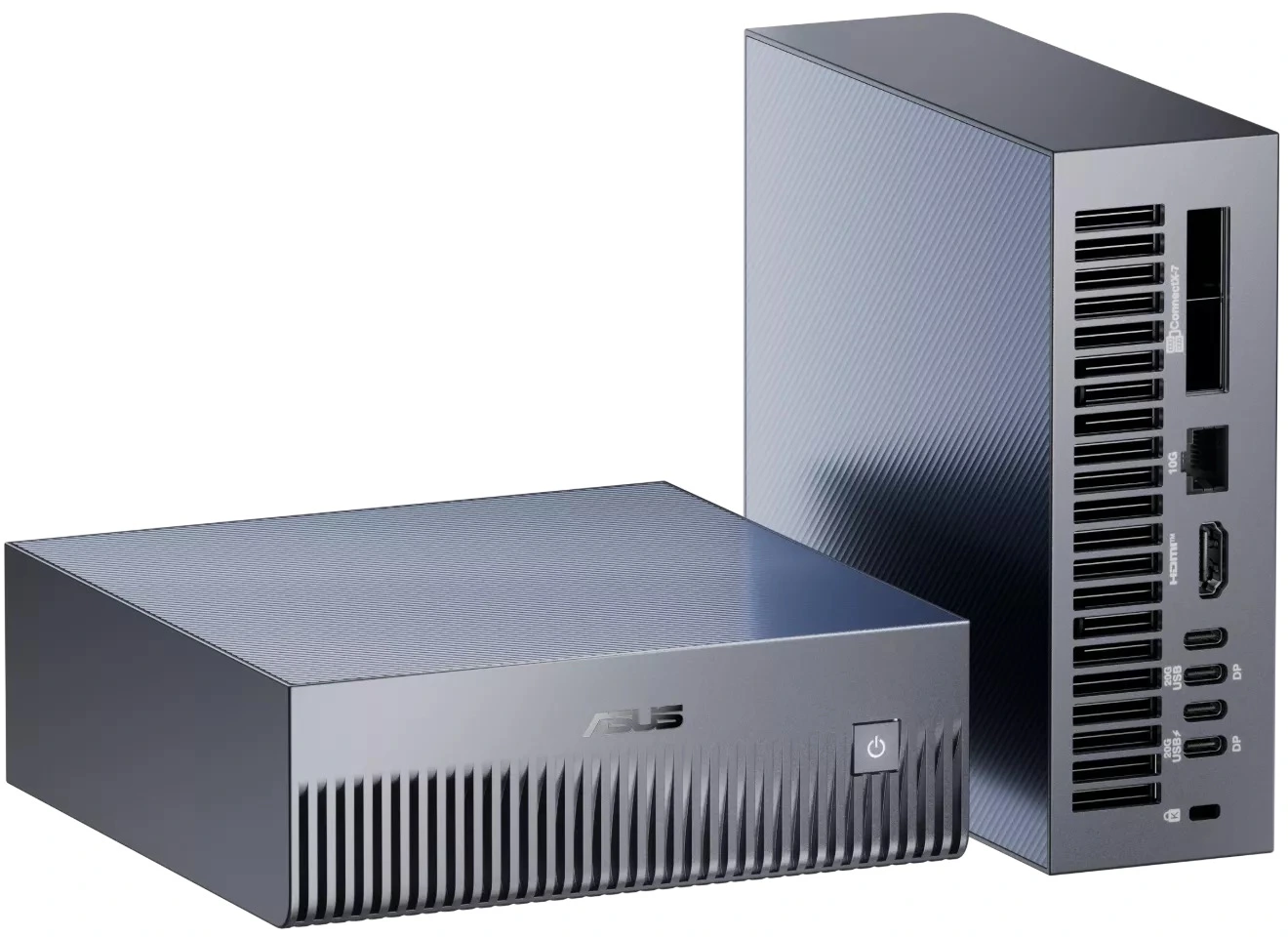
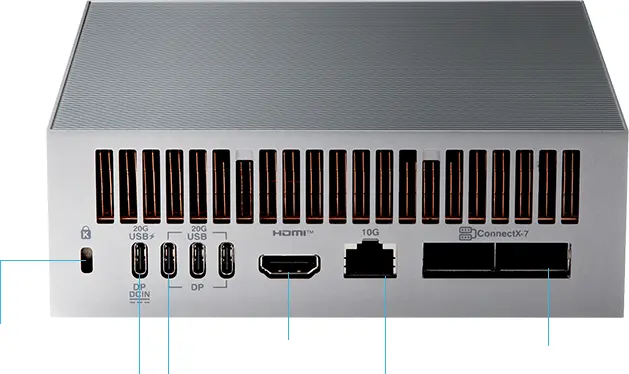
An NVIDIA ConnectX-7 Smart NIC with dual 200 Gbps QSFP112 ports handles both high-speed external networking and direct unit-to-unit linking for clustered configurations. Additional connectivity includes 10 GbE Ethernet (RJ-45), Wi-Fi 7 (MediaTek AW-EM637, 2×2 MIMO), and Bluetooth 5.4. I/O comprises 3 × USB 3.2 Gen 2×2 Type-C (20 Gbps) with DisplayPort 2.1 alt-mode, 1 × USB-C with Power Delivery, and HDMI 2.1. Combined outputs support up to 5 simultaneous displays, suiting multi-monitor development setups.
Design, Durability & Serviceability
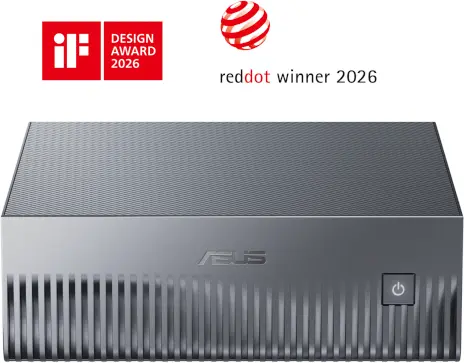
The Ascent GX10 places its power button on the front panel with an integrated status LED, keeping power state visible and controls reachable — particularly convenient when several units sit together for clustering. The chassis opens without tools, giving direct access to storage and memory for future upgrades. The unit is MIL-STD-810H tested for resistance to shock, vibration, and temperature extremes, and ships with TPM 2.0 and Secure Boot enabled for hardware-backed security.
Cooling & Thermal Efficiency
Thermal management is handled by QuietFlow, ASUS's dual vapor-chamber cooling system paired with dual 140 mm fans, five heat pipes (including one 8 mm pipe), and 7-level adaptive fan control. During sustained inference workloads, independent testing recorded CPU peaks of 87.3 °C and GPU peaks of 82 °C, with GPU power draw topping out at 69.77 W — figures consistent with stable, quiet operation across multi-hour inference and fine-tuning sessions.
Software & BIOS Tooling
Pre-installed NVIDIA DGX OS (Ubuntu-based) ships with the full NVIDIA AI software stack, including NVIDIA NIM microservices, Blueprints, PyTorch, and TensorRT, enabling immediate model deployment and fine-tuning. At the hardware level, ASUS's ROG-derived BIOS Suite brings fan-curve tuning, diagnostics, and low-level system monitoring familiar from ASUS's gaming and workstation lineups to the GB10 platform.
Architecture: Single, 2-Unit & 3-Unit Clustering
Every Ascent GX10 ships ready for clustering. Two units link directly via ConnectX-7 QSFP112 cabling for 2 petaFLOPS of combined performance and 256 GB of unified memory, suited to models of up to 405 billion parameters such as Llama 3.1 405B. A third unit can be added to the same fabric, raising combined memory to 384 GB and extending support to mixture-of-experts models of up to 800 billion parameters.
| Component | Single Unit | 2-Unit Cluster | 3-Unit Cluster |
|---|---|---|---|
| Total Memory | 128 GB LPDDR5x | 256 GB (2 × 128 GB) | 384 GB (3 × 128 GB) |
| Local Memory Bandwidth (per node) | 273 GB/s | 273 GB/s (per node) | 273 GB/s (per node) |
| Inter-Node Link | N/A | 200 Gbps (ConnectX-7 QSFP112, direct link) | 200 Gbps per link (multi-node fabric) |
| AI Performance | 1 petaFLOP | 2 petaFLOPS | 3 petaFLOPS |
| Max Model Parameters | 200B | 405B | 800B+ |
Single-Unit Performance
vLLM benchmarking on a single unit demonstrates strong throughput scaling under increased batch load:
| Model & Workload | Batch 1 | Batch 64 |
|---|---|---|
| GPT-OSS 120B (Equal ISL/OSL) | 70 tok/s | 680 tok/s |
| GPT-OSS 120B (Prefill Heavy) | 290 tok/s | 2,700 tok/s |
Fine-tuning workloads reach up to 53,000 tokens per second when applying LoRA adapters to Llama 3 8B, and creative workloads such as ComfyUI-based image generation complete a 1-megapixel image in approximately 216 seconds — both achievable on a single unit without clustering.
Pricing & Market Position
Entry Price: ₹3,82,033.02. Buyers who plan to scale beyond a single unit can add a second or third Ascent GX10 to the same ConnectX-7 fabric, extending both compute and unified memory while remaining within a single, NVIDIA-certified GB10 ecosystem.
Ecosystem & Future Scaling
The Ascent GX10 ships as an NVIDIA-certified system with direct roadmap alignment to NVIDIA's DGX Spark platform. Its 2-unit and 3-unit clustering options are both vendor-supported and covered under standard warranty terms, giving buyers a clear, low-risk path to scale local AI capacity as workloads grow.