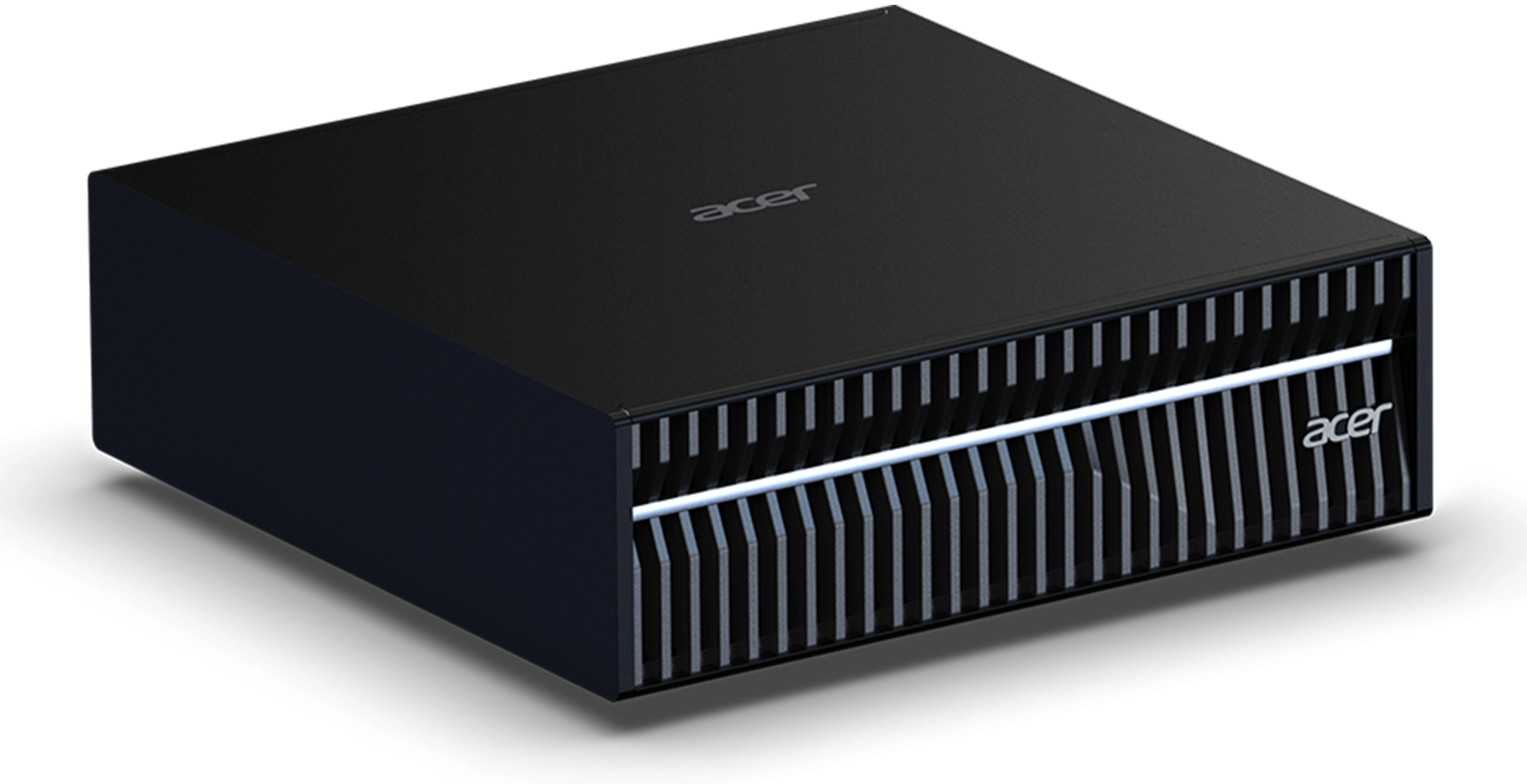
Acer Veriton GN100
Use this to tell your different configurations apart in your cart — handy if you order the same product with different options.
Full Specifications
Compute & Memory
Chip
NVIDIA GB10 Grace Blackwell Superchip
Unified Memory
128 GB LPDDR5x (273 GB/s bandwidth)
AI Performance
1 PetaFLOP (FP4)
Storage & Physical
Storage
4 TB NVMe Gen5 (Samsung PM9E1)
Dimensions
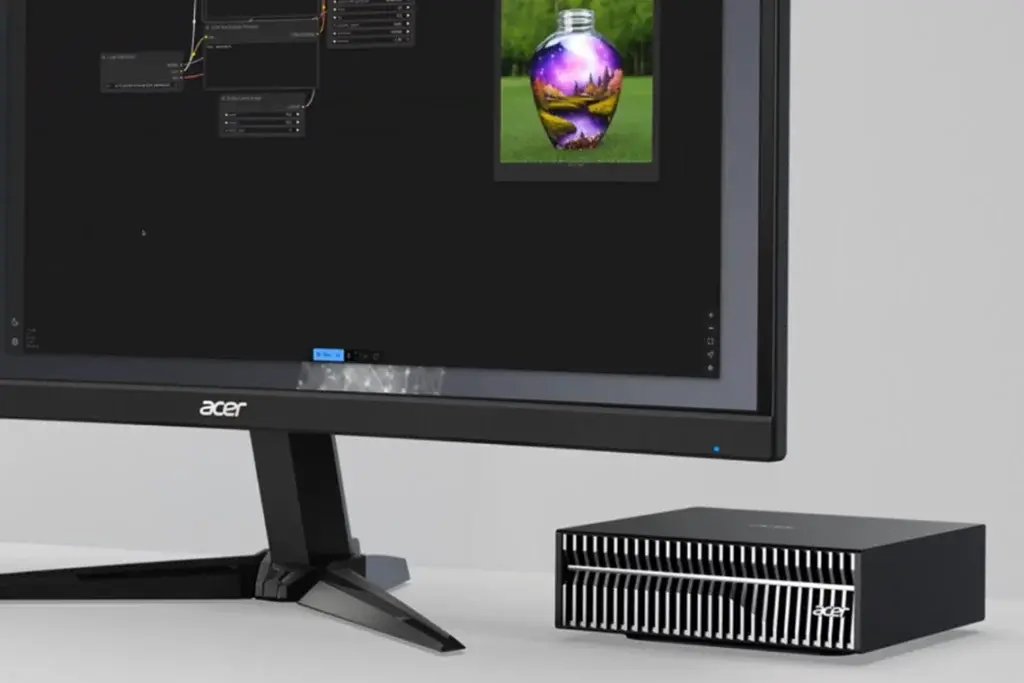
150 x 150 x 50.5 mm
Weight
1.2 kg
Power & Thermal
Power Supply
240 W USB-C PD adapter
GPU Power Draw
69.18 W
Cooling
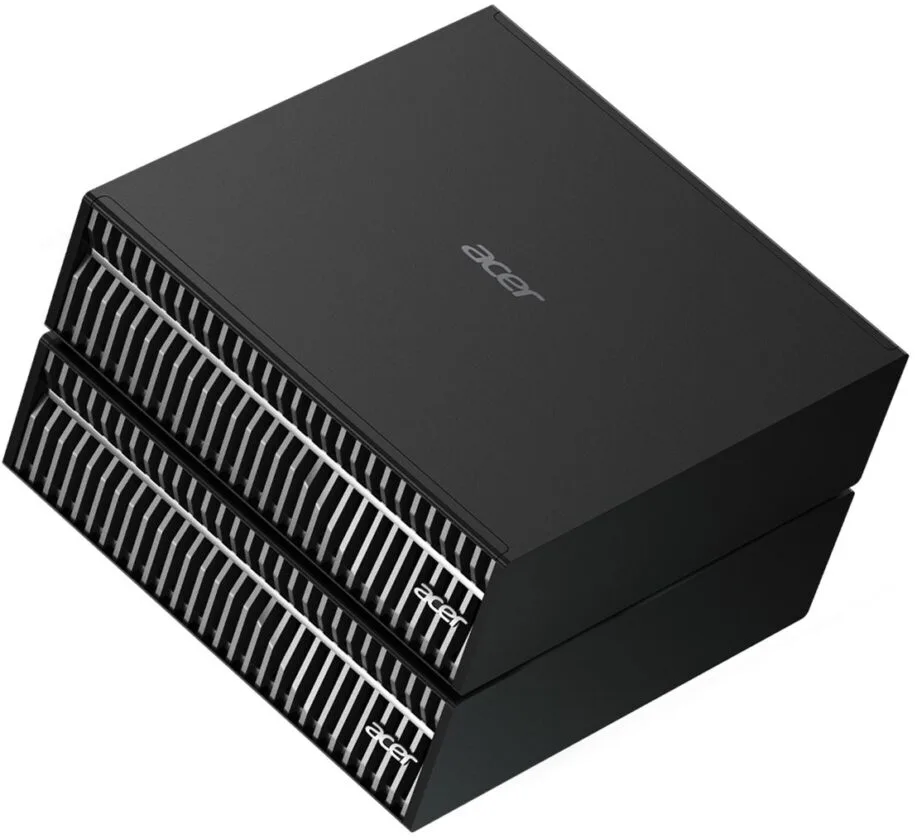
Vertical-slat front grille, low-temperature tuned
Thermal Profile
CPU: 74.7 °C peak · GPU: 69 °C peak
Extras
Security
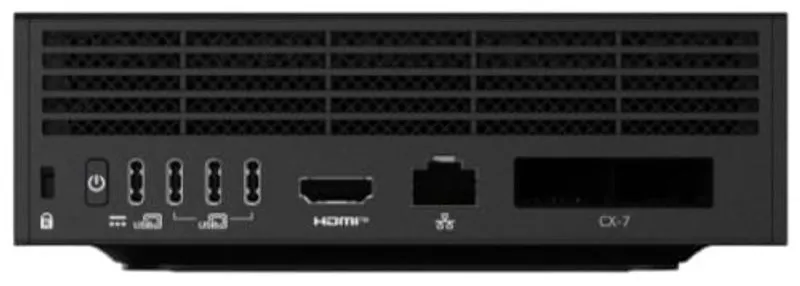
Kensington lock included, self-encrypting SSD
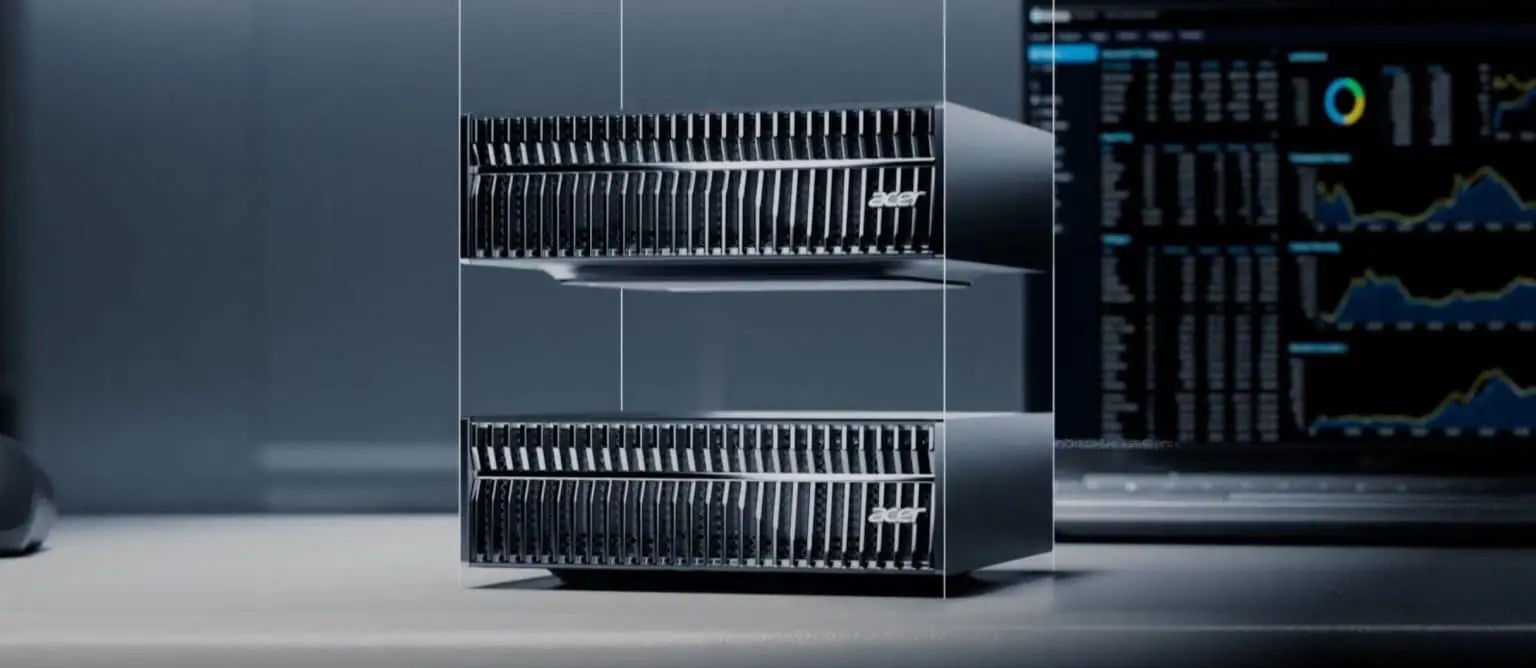
Acer first unveiled the Veriton GN100 on September 3, 2025 at IFA 2025. The original device allowed scaling up of two units to work with AI models reaching 400 billion parameters.
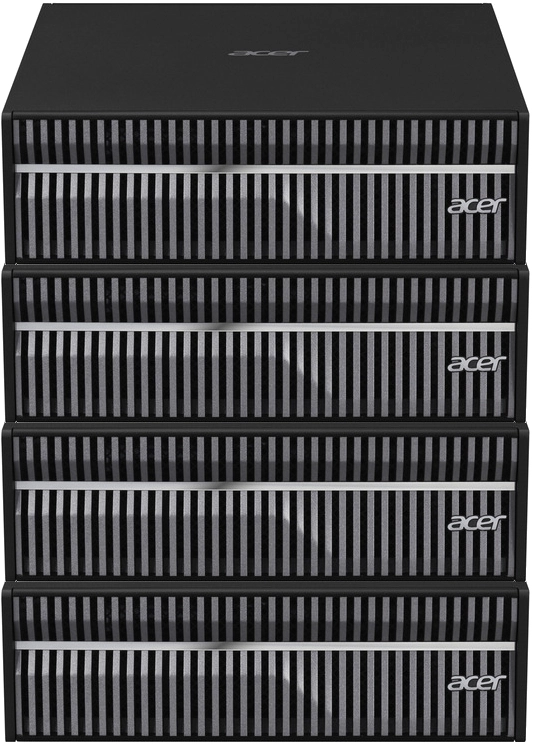
On April 9, 2026 Acer announced significantly expanded capabilities. The device now enables connecting up to four units for 512 GB memory that allows running larger AI models of up to 700 billion parameters. This ability is completely unique for the Acer device within the Nvidea GB10 Ecosystem as of the date of this writing (July 2026).
At NVIDIA's GTC 2026 conference in late March 2026, NVIDIA officially announced support for 4-node GB10 clusters. Acer became the first OEM partner to scale to 4 units.
While at the forefront of innovation in the GB10 ecosystem, the Acer Veriton GN100 combines the coldest independently-tested thermal profile in the GB10 class (CPU peak 74.7 °C, GPU peak 69 °C) with the lowest entry price, plus a unique AI TOP Utility (Acer Sense Pro) for real-time LLM benchmarking.
Hardware Specifications
The Veriton GN100 delivers 1 petaFLOP of FP4 AI performance in an ultra-compact form factor. It pairs a 20-core Arm-based processor (10 × Cortex-X925 performance cores + 10 × Cortex-A725 efficiency cores) with 128 GB LPDDR5x unified memory offering 273 GB/s bandwidth. Storage features a 4 TB PCIe Gen5 NVMe SSD—specifically a Samsung PM9E1, currently the fastest 2242 M.2 drive on the market—with native GPU Direct Storage (GDS) support for direct GPU-to-storage access, eliminating CPU bottlenecks in data-intensive workloads.
Connectivity & Networking
The Veriton GN100 integrates NVIDIA ConnectX-7 Smart NIC with dual 200 Gbps QSFP ports for direct unit-to-unit linking (2-unit) or managed RoCE switch fabric (4-unit). Additional connectivity includes 10 GbE Ethernet (RJ-45), Wi-Fi 7 (MediaTek AW-EM637, 2×2 MIMO), and Bluetooth 5.4. I/O comprises 4 × USB 3.2 Gen 2×2 Type-C (20 Gbps) with DisplayPort 2.1 alt-mode, 1 × USB-C with Power Delivery, and HDMI 2.1a. Physical security is ensured via Kensington lock slot and self-encrypting SSD.
Software & Real-Time Monitoring
Pre-installed NVIDIA DGX OS (Ubuntu 24.04 LTS) with the full NVIDIA AI software stack enables immediate deployment. Acer Sense Pro provides a centralized professional dashboard for real-time monitoring of CPU, GPU, memory, thermal, and workload metrics—critical for understanding system behavior under distributed inference. The platform includes integrated benchmarking tools for rapid AI model evaluation, allowing developers to baseline Llama, Qwen, Mistral, and custom models without external tools. Built-in diagnostics, community knowledge base access, and localized AI support agents accelerate troubleshooting.
Architecture: 2-Unit vs. 4-Unit Topology
All GB10 ecosystem devices support 2-unit peer-to-peer linking via direct QSFP DAC cables. As of 2026, some models support linking up to 3 units. This topology is simple but strictly limited to two or three units. The Veriton GN100 introduces an alternative: 4-unit clustering via managed RoCE 200 GbE Ethernet fabric with NVIDIA ConnectX-7 Smart NICs.
Memory & Bandwidth Architecture
| Component | Single Unit | 2-Unit Cluster (QSFP) | 4-Unit Cluster (RoCE 200GbE) |
|---|---|---|---|
| Total Memory | 128 GB LPDDR5x | 256 GB (2 × 128 GB) | 512 GB (4 × 128 GB) |
| Local Memory Bandwidth (per node) | 273 GB/s | 273 GB/s (per node) | 273 GB/s (per node) |
| Inter-Node Link Capacity | N/A | ~400 Gbps (DAC, peer-to-peer) | 200 Gbps × 3 links = 600 Gbps (switch fabric) |
| Inter-Node Link Latency | N/A | ~1–2 μs | ~10–15 μs (Ethernet + RoCE overhead) |
| Max Model Parameters | 200B | 400B | 700B+ |
RoCE 200 GbE Fabric: Technical Details
The 4-unit cluster uses Remote Direct Memory Access over Converged Ethernet (RoCE) v2 on 200 GbE links. Key implications:
- Hardware-Accelerated RDMA: The ConnectX-7 NIC offloads memory transport to dedicated silicon, eliminating CPU involvement in remote memory access. This reduces latency overhead compared to software-based networking.
- Coherent Memory Model: RoCE enables a single logical address space across all 4 nodes. Distributed inference frameworks (vLLM, TensorRT-LLM) can treat the 512 GB cluster as a coherent pool rather than managing explicit inter-node communication.
- Bandwidth Trade-off: While 200 Gbps per link is substantial, cross-node bandwidth (~25 GB/s per direction) is ~10× slower than local bandwidth (273 GB/s). This means models spanning multiple nodes incur significant latency overhead during tensor-parallel distributed inference, which is acceptable for batch workloads but that could be challenging for interactive latency-sensitive applications.
- Managed Switch Topology: Unlike 2-unit peer-to-peer cabling, 4-unit clusters require a managed Ethernet switch with RoCE support. This adds infrastructure requirements.
Thermal Efficiency & Power Management
Independent thermal testing by Storage Review places the Veriton GN100 at the cooling leadership position within the GB10 class. During sustained inference workloads spanning prefill-heavy, balanced (Equal ISL/OSL), and decode-heavy phases:
- CPU Temperature: Peaks at 74.7 °C during burst activity; maintains well-controlled sustained temperatures without climbing into the 80 °C range observed in competing units.
- GPU Temperature: Reaches only 69 °C peak—the coolest in the comparison group—indicating efficient thermal design.
- Power Draw: GPU peaks at 69.18W, slightly below the highest in the stack, reflecting Acer's balance of performance and thermal efficiency over aggressive power utilization.
- NVMe/NIC Temps: NVMe remains under 57 °C; NIC peaks at 61 °C, both well within safe operating ranges.
This thermal conservative approach translates to sustained stability during multi-hour inference sessions and extended fine-tuning runs, critical for production SMB deployments where downtime carries operational cost.
Single-Unit Performance Baseline (Production Ready)
Storage Review's comprehensive vLLM benchmarking across three workload patterns demonstrates the single unit's production viability:
| Model & Workload | Batch 1 | Batch 8 | Batch 32 | Batch 64 |
|---|---|---|---|---|
| Llama 3.1 8B (FP4) | 77 tok/s | 342 tok/s | 1,359 tok/s | 2,835 tok/s |
| GPT-OSS 120B (Equal ISL/OSL) | 70 tok/s | 177 tok/s | 497 tok/s | 713 tok/s |
| GPT-OSS 120B (Prefill Heavy) | 304 tok/s | 871 tok/s | 2,100 tok/s | 2,778 tok/s |
| Qwen3 30B (FP8) | 105 tok/s | 356 tok/s | 875 tok/s | 1,273 tok/s |
Pricing & Market Position
Entry Price: ₹3,82,033.02. This represents the lowest price in the GB10 class, while delivering identical or better core specifications. The price-to-performance ratio is strengthened by the unmatched thermal profile, reducing cooling infrastructure costs, and the integrated Acer Sense Pro benchmarking suite.
Ecosystem & Future Scaling
The Veriton GN100 ships as an NVIDIA-certified system with direct roadmap alignment to NVIDIA's DGX Spark evolution. The 4-unit capability announced April 9, 2026 demonstrates Acer's commitment to innovation. Unlike experimental 8–16 node configurations (used in community research), Acer's 4-unit topology is officially supported by NVIDIA, vendor-backed, and included in warranty coverage.