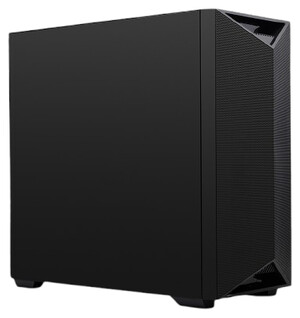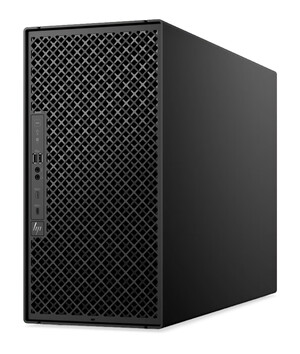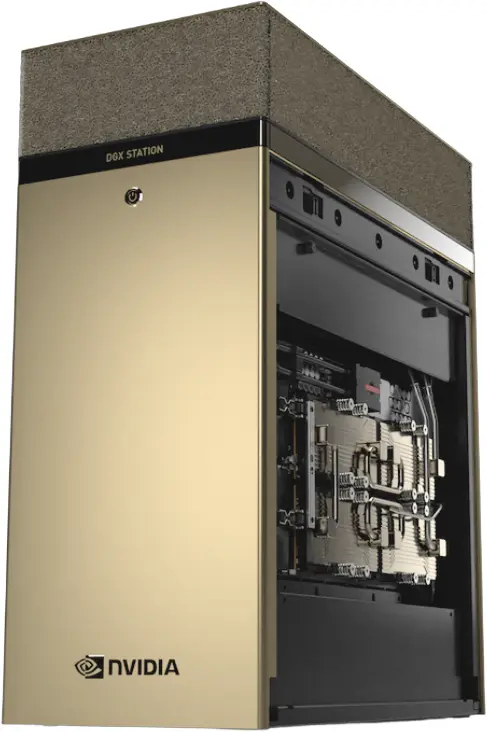
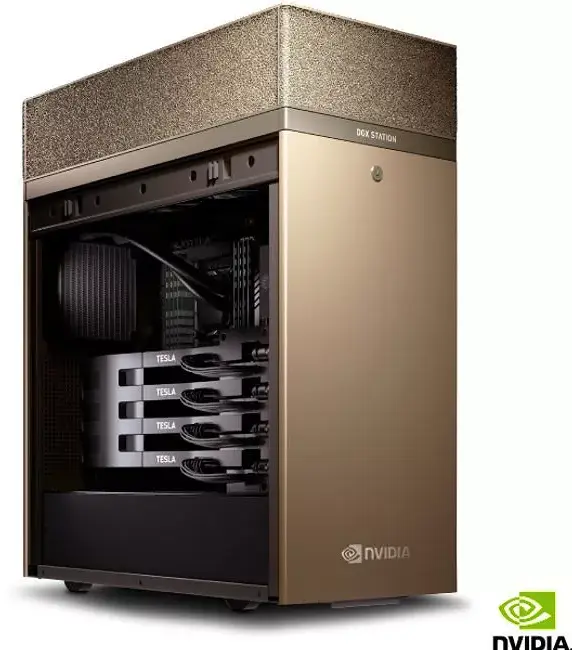
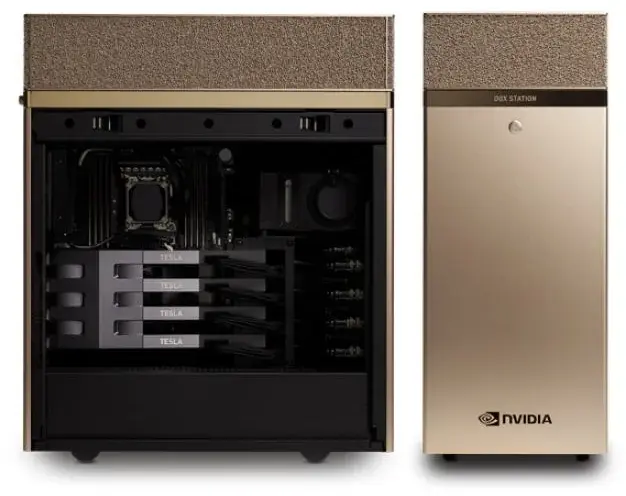
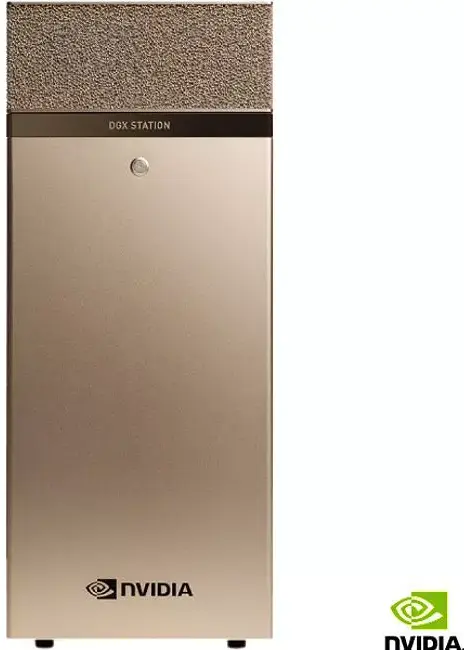
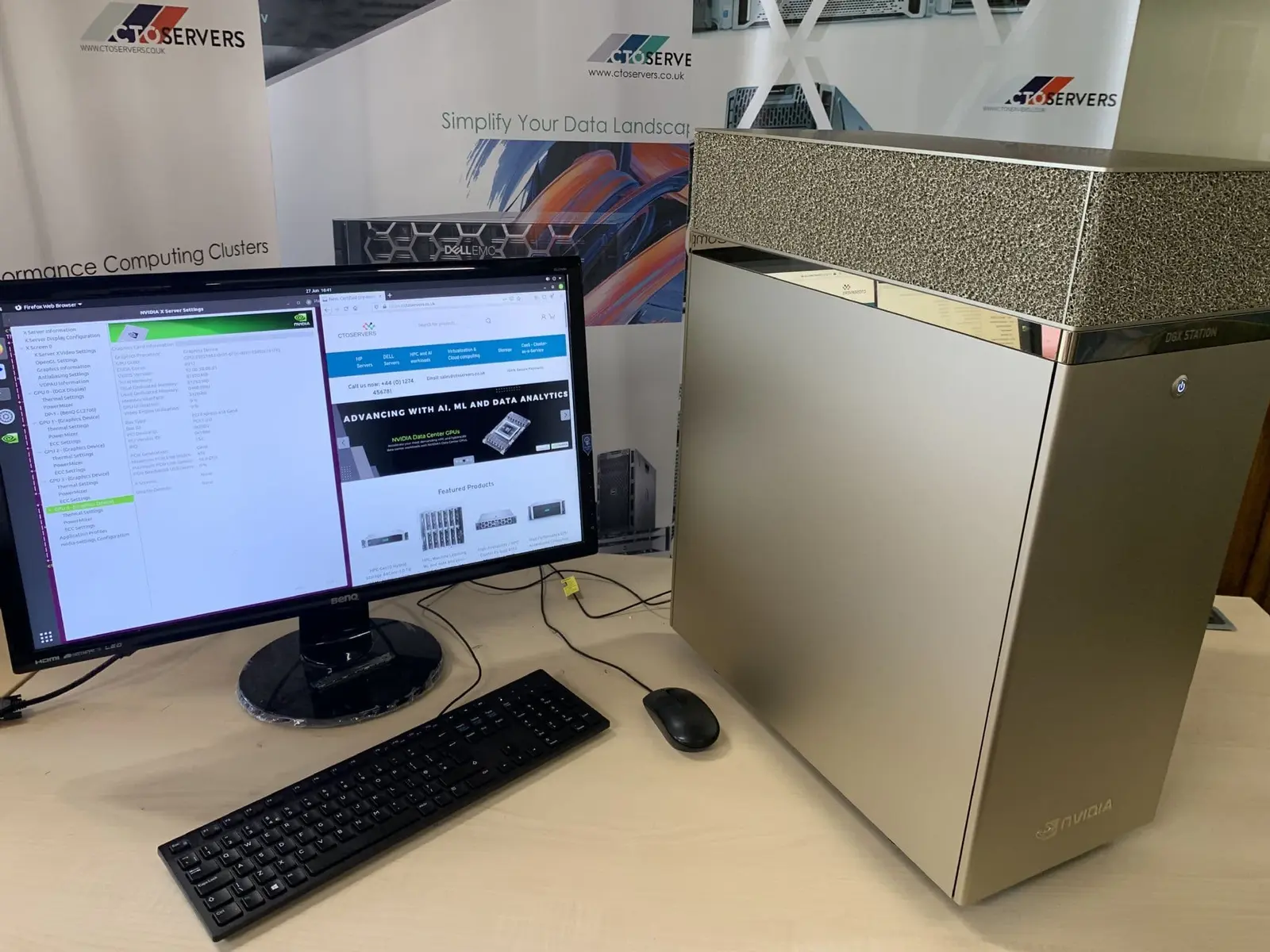
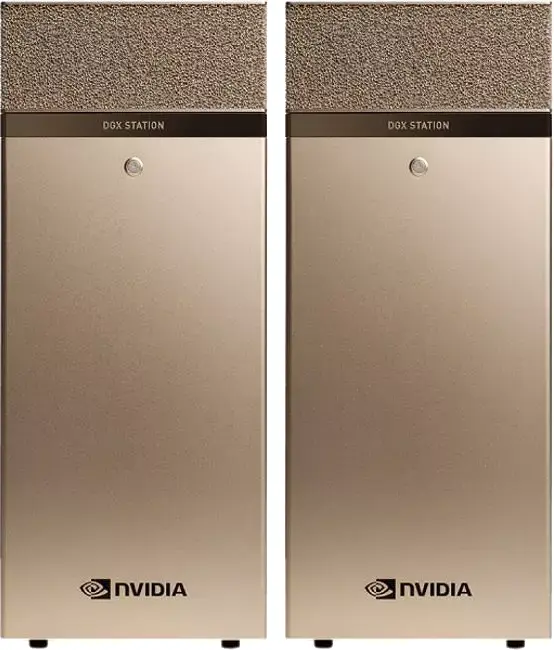
NVIDIA DGX Station AI Workstation
Use this to tell your different configurations apart in your cart — handy if you order the same product with different options.
Full Specifications
Compute & Memory
Superchip
NVIDIA GB300 Grace Blackwell Ultra Desktop Superchip
CPU
1× NVIDIA Grace CPU Superchip, 72 Arm Neoverse V2 cores
GPU
1× NVIDIA Blackwell Ultra GPU
Coherent Memory
748 GB unified: 496 GB LPDDR5X + 252 GB HBM3e
Memory Interconnect
NVLink-C2C, 900 GB/s CPU–GPU bandwidth
AI Performance
20 PetaFLOPS (FP4)
Multi-Instance GPU
Up to 7 isolated GPU partitions (MIG)
Storage & Physical
Storage (Slots)
4× M.2 2280 PCIe 5.0 x4 NVMe
GPU Expansion
PCIe 5.0, 1× double-width + 2× single-width x16 slot(s) for optional NVIDIA RTX PRO display/visualization GPU
Form Factor
Deskside tower, NVIDIA reference chassis design
Dimensions
24.5 x 52.8 x 59.5 cm
Networking & Clustering
High-Speed Networking
2× 400G QSFP112 ports via NVIDIA ConnectX-8 SuperNIC
Multi-Station Clustering
Direct 400GbE linking of up to 2 DGX Stations into a combined 1,496 GB coherent memory pool
Wireless (Optional)
PCIe M.2 2230 slot for a Wi-Fi/Bluetooth module; can be left unpopulated for air-gapped deployments
Power & Thermal
Power Supply
1600 W power supply, standard office outlet compatible
Cooling
Closed-loop liquid cooling, sustained performance under heavy AI workloads
Management & Software
BMC
ASPEED AST2600
Remote Management
IPMI 2.0 and Redfish API, data-center-style monitoring and control
Security
Hardware root of trust, enterprise secure boot
Software Stack
NVIDIA DGX OS, ready for NVIDIA NemoClaw agent deployment
NVIDIA introduced the DGX Station on March 17, 2026, as the reference deskside system for the NVIDIA GB300 Grace Blackwell Superchip platform — designed and validated directly by NVIDIA to run trillion-parameter models locally, and produced under license by NVIDIA's hardware partners.
Hardware Specifications
The DGX Station is built around a single NVIDIA Grace CPU Superchip — 72 Arm Neoverse V2 cores and 496 GB LPDDR5X memory — paired with an NVIDIA Blackwell Ultra GPU with 252 GB HBM3e GPU memory, unified through NVLink-C2C into a coherent memory pool of 748 GB. Up to 7 isolated MIG partitions let a single station serve several teams or workloads at once without contention. The system provides 4× M.2 2280 PCIe 5.0 x4 NVMe storage, a dual-port NVIDIA ConnectX-8 400G SuperNIC, and PCIe 5.0 expansion slots for an optional NVIDIA RTX PRO GPU dedicated to display and visualization output.
Local AI Server for Business Use
The DGX Station is designed to function as a shared local AI resource. Multiple employees can submit document processing tasks — contract review, invoice extraction, report drafting, email triage — throughout the working day, with jobs handled centrally on-site instead of routed through external cloud services.
Through NVIDIA NemoClaw, autonomous agents can run continuously on the system, handling recurring tasks such as inbox monitoring or scheduled report generation without requiring a person to initiate each request. This allows the DGX Station to operate as ongoing AI infrastructure for the business, supporting steady document workloads.
Expanding Capacity: Two-Station Clustering
For workloads that outgrow a single unit, two DGX Stations can be connected over their onboard 400G ConnectX-8 SuperNIC ports, combining into a single 1,496 GB coherent memory pool addressable across both machines. This provides a straightforward upgrade path for growing teams without requiring a new architecture or workflow changes, available as a configuration option at checkout.
A Reference Platform Built on Nine Years of DGX Station Development
The DGX Station name traces back to 2017, when NVIDIA introduced the original DGX Station as a deskside alternative to rack-mounted AI infrastructure, built around four NVIDIA Tesla V100 GPUs. In November 2020, the DGX Station A100 succeeded it, moving to four NVIDIA A100 Tensor Core GPUs and offering up to 320 GB of GPU memory spread across four separate cards, each requiring workloads to be explicitly distributed and managed across the multi-GPU configuration.
The current DGX Station, introduced in 2026, replaces that multi-GPU approach with a single NVIDIA GB300 Grace Blackwell Ultra Superchip: one coherent, unified memory pool of 748 GB shared directly between CPU and GPU over NVLink-C2C, rather than four separate GPU memory pools stitched together in software.
Coherent memory capacity, by generation
One coherent memory pool, shared directly between CPU and GPU — no manual multi-GPU partitioning required.
Cost Comparison: On-Premises vs. Cloud AI APIs
For SMBs processing high volumes of documents on a daily basis, the difference between a fixed on-premises system and usage-based cloud AI billing compounds significantly over time.
| Cost Category | Cloud AI APIs | DGX Station (On-Premises) |
|---|---|---|
| Initial hardware investment | None | $105K (one-time) |
| Year 1 operating cost | ~€100k – ~€200k | ~€4k (power & maintenance) |
| Year 2 operating cost | ~€100k – ~€200k | ~€4k (power & maintenance) |
| Year 3 operating cost | ~€100k – ~€200k | ~€4k (power & maintenance) |
| Cumulative 3-year cost | ~€300k – ~€600k | 11463857 INR |
Because processing takes place entirely on-site, documents and business data are not transmitted to third-party servers. This is a relevant consideration for organizations in legal, financial, or other data-sensitive sectors.
Summary
The DGX Station provides a single, fixed-cost system capable of supporting continuous AI document processing, combined with the reference NVIDIA architecture for running large AI models locally. For SMBs with sustained AI workloads, it offers a lower cost alternative to recurring cloud AI expenditure, with a documented upgrade path to a two-station cluster.