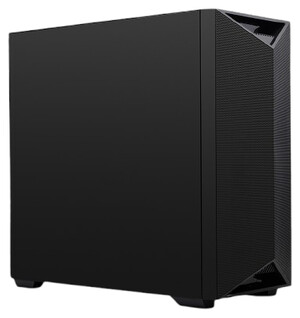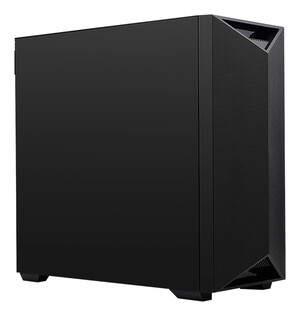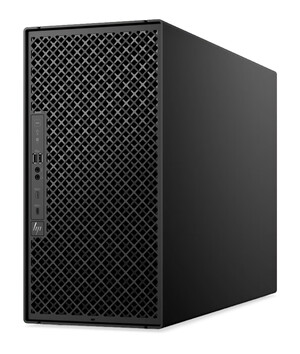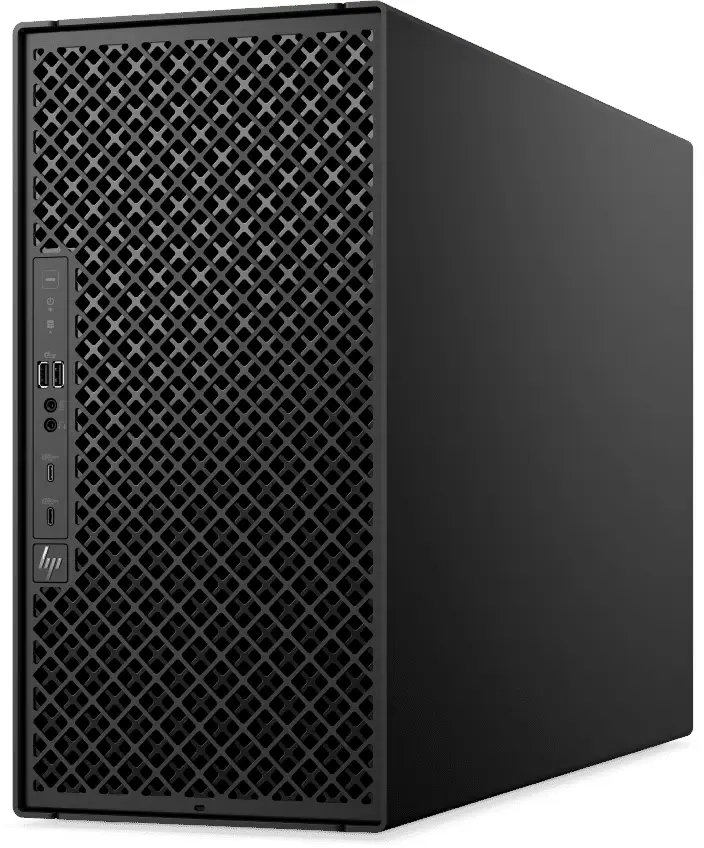
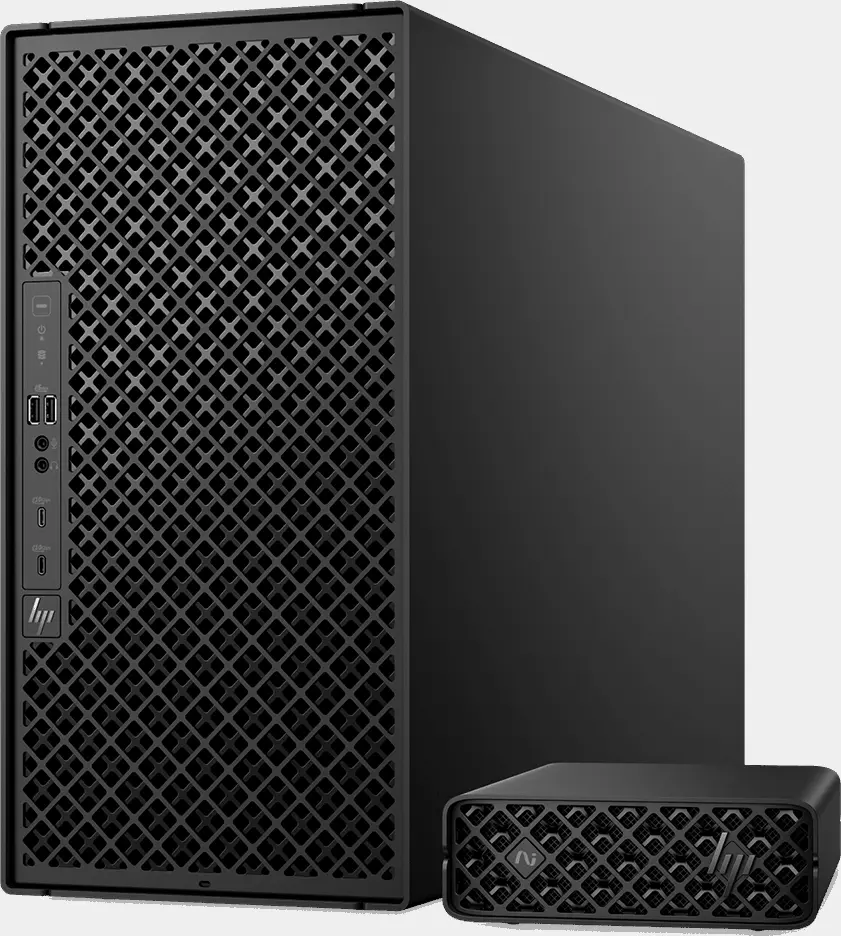
HP ZGX Fury GB300 AI Workstation
Use this to tell your different configurations apart in your cart — handy if you order the same product with different options.
Full Specifications
Compute & Memory
Superchip
NVIDIA GB300 Grace Blackwell Ultra Desktop Superchip
CPU
1× NVIDIA Grace CPU Superchip, 72 Arm Neoverse V2 cores
GPU
1× NVIDIA Blackwell Ultra GPU
Coherent Memory
748 GB unified: 496 GB LPDDR5X + 252 GB HBM3e
AI Performance
20 PetaFLOPS (FP4)
Storage & Physical
Storage (Slots)
Up to 4× M.2 2280 PCIe 5.0 x4 NVMe (8 TB max)
Form Factor
Deskside tower, NVIDIA DGX Station architecture
Dimensions
24.78 x 58.27 x 52.79 cm
Networking & Expansion
High-Speed Networking
2× 400G QSFP112 ports via NVIDIA ConnectX-8 SuperNIC
PCIe Expansion
PCIe 5.0, 3 slots (1× x16 + 2× x8), supports NVIDIA RTX Pro 6000 / 4000 / 2000 GPUs
Power & Thermal
Power Supply
1600 W Titanium-efficiency PSU, 115–240V flexible
Cooling
Air-cooled tower, standard office power and airflow requirements
Management & Software
Operating System
Ubuntu, with Windows support planned as a future addition
Software Stack
HP ZGX Toolkit(free, open-source), pre-configured with the NVIDIA AI software stack
Agent Runtime
NVIDIA NemoClaw with isolated sandboxing for autonomous agents
HP introduced the ZGX Fury GB300 on June 6, 2026 at Computex, positioning it within the NVIDIA GB300 Grace Blackwell Superchip ecosystem as a deskside system built to run trillion-parameter models locally, with a software stack purpose-built for continuously running AI agents.
Hardware Specifications
The ZGX Fury GB300 is built around a single NVIDIA Grace CPU Superchip — 72 Arm Neoverse V2 cores and 496 GB LPDDR5X memory — paired with an NVIDIA Blackwell Ultra GPU with 252 GB HBM3e GPU memory, unified through NVLink-C2C into a coherent memory pool of 748 GB. The system provides up to 4× M.2 2280 PCIe 5.0 NVMe storage (8 TB total), a dual-port ConnectX-8 400G network interface, and three additional PCIe 5.0 slots for optional RTX Pro GPU expansion.
Local AI Server for Business Use
The ZGX Fury GB300 is designed to function as a shared, on-site AI resource. Multiple employees can submit document processing tasks — contract review, invoice extraction, report drafting, email triage — throughout the working day, with jobs handled centrally on-site instead of routed through external cloud services.
The system ships with the HP ZGX Toolkit, a free, pre-configured software stack, alongside NVIDIA NemoClaw for running always-on autonomous agents. Agents operate inside an isolated OpenShell sandbox, allowing recurring tasks such as inbox monitoring or scheduled report generation to run continuously without a person initiating each request, while keeping agent activity contained and auditable.
HP has committed to enabling support for future NVIDIA GPU generations on the same system, and Windows support is planned to join the current Ubuntu-based environment later in 2026 — extending the useful lifetime of the initial hardware investment.
Cost Comparison: On-Premises vs. Cloud AI APIs
For SMBs processing high volumes of documents on a daily basis, the difference between a fixed on-premises system and usage-based cloud AI billing compounds significantly over time.
| Cost Category | Cloud AI APIs | ZGX Fury (On-Premises) |
|---|---|---|
| Initial hardware investment | None | ₹90 L (one-time) |
| Year 1 operating cost | ~€100k – ~€200k | ~€4k (power & maintenance) |
| Year 2 operating cost | ~€100k – ~€200k | ~€4k (power & maintenance) |
| Year 3 operating cost | ~€100k – ~€200k | ~€4k (power & maintenance) |
| Cumulative 3-year cost | ~€300k – ~€600k | ~₹1.05 Cr |
Because processing takes place entirely on-site, documents and business data are not transmitted to third-party servers. This is a relevant consideration for organizations in legal, financial, or other data-sensitive sectors.
Summary
The ZGX Fury GB300 provides a single, fixed-cost system capable of supporting continuous AI document processing, combined with an open, extensible software stack for deploying autonomous agents. For SMBs with sustained AI workloads, it offers a lower cost alternative to recurring cloud AI expenditure, without tying the business to a single software vendor.